
Self Management
The steps we can take to regulate emotion and be more self disciplined.


This morning was one of those mornings. If traffic to and from my daughter’s school was normal I had 15 minutes spare before a work call… but traffic was not normal.
Multiple accidents, getting caught behind a driver doing 20mph in a 30 zone, roadworks causing diversions, roadworks blocking roundabouts, hitting every red light on the route, and to top it off, a car towing a van at 5mph… My heart rate increased and a few frustrated noises were made.
It was halfway through the return journey that I finally clocked that the heightened heart rate and feeling of frustration was under my control but I was letting it control me.
I had told myself the story that I was entitled to get to where I need to be in the time I needed to get there without anyone else in the world impacting my journey.
As soon as I decided to not believe that story and take a few deep breaths, I could laugh at the last few red traffic lights and accept that I’d just have to be a bit late. I also thought that it was an appropriate time to put into practice what I’d been writing about in this post!
Over the next few weeks I’m exploring four elements of Emotional Intelligence (EI for short but also known as EQ) and how we can develop our EI to improve both our wellbeing and our relationships. While there is some research to suggest that there is a percentage of people who may be unable to develop their EI for various reasons, I’ll be aiming this series at the majority of people who have some emotional awareness and an ability to build on that foundation.
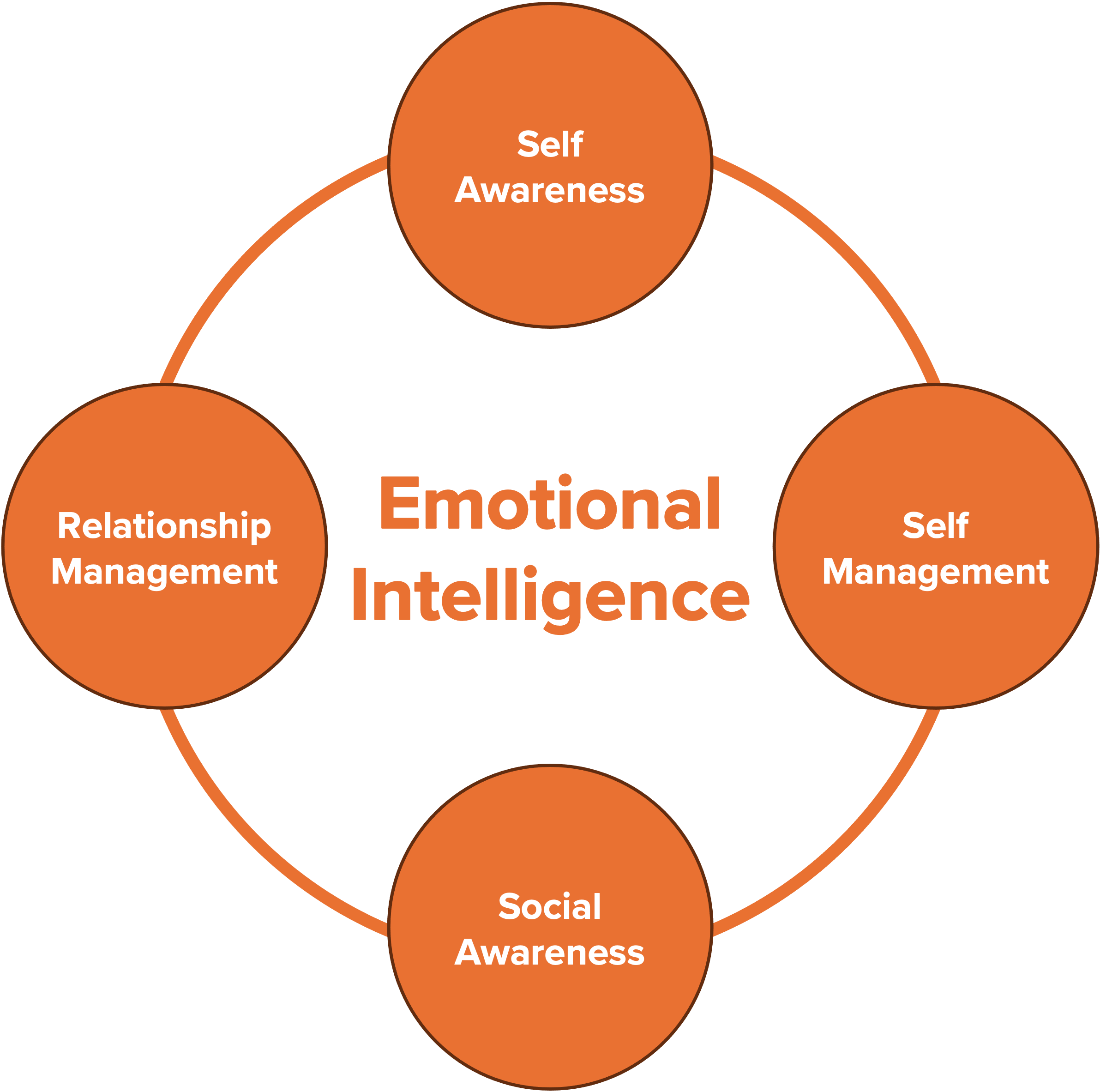
EI is said to comprise of Self Awareness, Self Management, Social Awareness, and Relationship Management. I’ll define each one in turn, highlight the research behind its importance, and then provide a few resources and activities that are designed to develop the skill. If you’ve missed either of the previous posts, then you can click each topic above to go to the relevant post.
The more I’m digging into EI, the more I’m realising there are multiple frameworks1 and more detailed breakdowns of the various elements of EI. Some resources that test for EI may well provide other competencies beyond the scope of this series, but they show that there is much more to cover in future! For now, the four domains as defined by Daniel Goleman (see introduction on EI for his breakdown) will be the focus of this series of posts.
What is Self Management?
Self Management, in the sense it was defined by Daniel Goleman, is about the control or regulation of emotions and avoiding “hijack” of the brain by overwhelming thoughts or feelings such as frustration2. Self Awareness enables Self Management as it helps you recognise what you are feeling in the moment and is the ability to label accurately each emotion and recognise how this is impacting behaviours and decisions.
Beyond the regulation of emotions, Self Management also includes discipline in actions. What we do and how we behave can impact our emotions, be it positively or negatively, as we’ll explore in a moment.
There are many myths3 around emotions and the ability to control them but two that need to be recognised at this point are that certain emotions are “bad” and therefore shouldn’t be expressed in any form, and that emotion can’t be controlled. Both of these myths, when believed and lived out, hinder self management.
What are emotions?
This might seem an obvious question but I’ve learnt a lot about emotion over the last couple of years as various life moments have hit hard. Emotions are your brain telling a story about what your body is doing. What your brain interprets as anxiety in one situation may be excitement in another - the heart racing, the sweaty palms, the fidgeting, are all very similar in terms of physiology, but are interpreted as differing emotions by your brain.
This story the brain tells is usually more a prediction based on past experience than what is an appropriate response to the situation. This means we can be more curious about our interpretation of what our body is doing rather than judging the emotion as a fact. Dr Lisa Feldman Barrett goes into this in more detail in her TED Talk below.
This knowledge along with the fact that the wave of emotion physiologically lasts on average 90 seconds4, means we do have more control over our emotions than we might have thought.
Regulating Emotions
Author of My Stroke of Insight, Jill Bolte Taylor, says that when you are feeling emotionally triggered by something,
“Look at the second hand on a watch. As soon as you look at it, you’re now observing yourself having this physiological response instead of engaging with it. It will take less than 90 seconds, and you will feel better.5
There is something about observing and being aware of an emotion without judgement that is a key part of regulation. We can then make a choice about how we react or not to the situation. If we judge a feeling as good or bad, we tell ourselves a story and make meaning of something that we can’t necessarily control and then add more feelings like guilt or shame.
Non-judgemental observation helps us interact more appropriately with events around us and process what is appropriate, and what is not, without making things worse for ourselves. Anger and sadness are legitimate responses to situations as is happiness and excitement. Labelling them good or bad stops us engaging with them appropriately. Karla Maclaren notes in her article on The Myth of Positive Emotions,
When we think of emotions in these positive and negative ways, we tend to feel comfortable only when positive emotions arise.
This is a big part of why we’re so uncomfortable around most emotions; we’ve been taught to treat most of them as problems instead of as necessary and valuable parts of our lives.
Another problem: There are a lot more of the so-called negative emotions than there are of the so-called positive ones, which means that most of us feel comfortable with only a very small percentage of our emotions.6
Un-learning that certain emotions are “bad” takes time, especially if you’ve had experiences where expressing an emotion has been used against you. It is worth taking the time to reflect on what emotions you shut down and avoid because you think they are wrong or bad.
What would change if you accepted your emotions for what they are and then made a choice about how you’d respond?
Developing Self Management
An important part of developing Self Management is being open to change. If we do not accept that change can happen, feedback can make us defensive because we can conflate what we have done as equal to who we are. We can become stuck in bad habits that cause difficult emotions to spiral, and we can avoid taking on new skills and opportunities that will be of benefit to us.
Once we are open to change, we can start to engage with disciplines that can develop Self Management. These include but aren’t limited to, sleep, exercise, diet, time management, healthy boundaries, goal setting, self motivation, and taking and acting on feedback. Each of these deserve a blog post on their own but I’ll focus on the first three as I believe they are the most important but also the most neglected - particularly sleep.
Sleep
If you are struggling with regulating your emotions and finding that you are acting from impulse, the first thing to reflect on is your sleep. Poor health may create poor sleep but poor sleep will create poor health7 - mentally and physically. If we don’t get enough sleep our mood changes and we are more likely to be more irritable, likely to eat poorly and gain weight, exercise less, have impaired cognitive function, and reduced immune function.8 In turn, this will impact our ability to work well and our relationships.
If you want to develop Self Management, start prioritising your sleep.
Diet
My nutritionist friends would have plenty to say on this point and I’m certainly not an expert! However, it is very clear that what we eat, or don’t eat, impacts our emotions, our ability to work well, and our ability to relate well to others. Making sure to have a balanced diet, making use of healthy snacks, and keeping hydrated, is a foundational Self Management skill9.
Exercise
You don’t have to run ultra marathons or even run at all. Exercise that helps wellbeing and regulation of emotions starts with a brisk 10 minute daily walk10. Exercise is particularly good at getting us away from the noise of our phones and screens (though this isn’t necessarily the case in gyms!) which in turn gives our brains space to process without extra unhelpful input. Whether it is the time to process the causes of stress, releasing pent-up aggression, or just getting the release of endorphins after the fact, exercise is a proven method to help regulate emotion11.
Continuing development
If you have begun to develop good habits around sleep, diet, and exercise, then it is likely you’ve started developing the skills of time management, healthy boundaries, goal setting, and self motivation. If you’ve hired a coach to help with some of this work then it may be you’ve started taking and acting on feedback as well!
Conclusions
Self Management requires continual development. It is intrinsically linked to Self Awareness and so the more we develop our Self Awareness, the more we are likely to find areas that need development in Self Management - and vice versa.
Self Management is also connected to behavioural change and motivation12 and both of these are best achieved with supportive peers who can hold us accountable or professionals such as coaches. Doing this on your own may get you part of the way, but Emotional Intelligence is also about understanding how we are perceived by others, and that requires us to do this work by engaging with and hearing from those around us. More on that in the next EI domain - Empathy.
← Previous post in this series | Next post in this series →
If you are interested in exploring EI and how we can learn and develop EI over the next few weeks then why not hit subscribe. You’ll get each article in your inbox - usually 9am on a Friday morning. A paid subscription will also get you a complimentary coaching session as well as support what I do. Get in touch if you’d like to know more!
Resources
Why Has Nobody Told Me This Before? By Dr Julie Smith - an excellent resource on managing thoughts and emotions.
Modern Wisdom Podcast with Dr Lisa Feldman Barrett - this is bit of a meandering conversation exploring emotions, how they originate, and whether we have some control over our emotions. Scientific, philosophical, and at some points a bit uncertain on where it is heading, this conversation was helpful but take it as listening in to a conversation with an expert who is thinking on her feet, not a seminar.
Another conversation on emotional regulation by a father and son duo, the father being a clinical psychologist.
For a more detailed look at Emotional Intelligence utilising EQ-i 2.0, Andi Roberts goes into more detail - relevant to Self Management would be Self Expression, Decision Making, and Stress Management.
One such assessment framework is EQ-i 2.0 which breaks down EI into 5 domains with multiple sub-domains.
https://m1psychology.com/myths-of-emotions/ and https://www.therapistaid.com/therapy-worksheet/emotion-myths are just two sources for lists of myths!
See #4
For a simple and helpful starting point on a balanced diet: https://www.mentalhealth.org.uk/explore-mental-health/a-z-topics/diet-and-mental-health
See heading “What can help to improve self management?” here: https://www.psychologytoday.com/us/blog/metamorphosis/202204/successful-self-management-the-goal-emerging-adulthood