
Cultural Intelligence
How do we navigate cultural differences well?


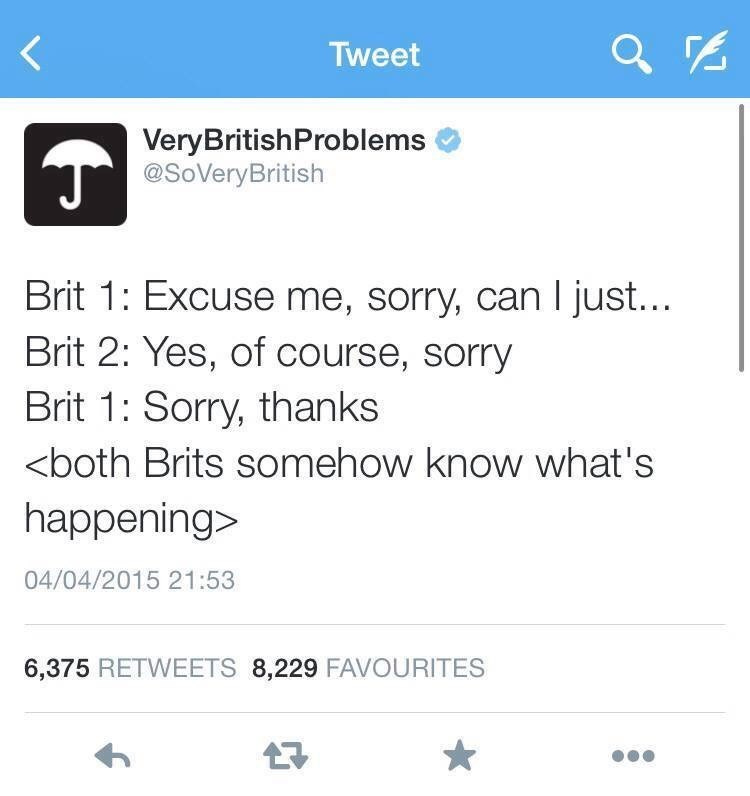
The visiting researcher was finding life with her landlady increasingly difficult. There was a lack of clear body language as to how the landlady felt about her, she thought they were friendly when she moved in, but now she wasn’t sure. “Please”, “thank you”, and “sorry “ was said so frequently they seemed insincere. Her own communication didn’t seem to be received in the ways she intended and she began to realise that she was inadvertently offending her landlady and couldn’t figure out why.
Fortunately the researcher and the landlady were aware and mature enough to recognise the issue before it spiralled further. They met together to discuss what was happening. The researcher was living in the UK, visiting from India, and the landlady was English. They started talking about how they were impacted by the other’s behaviour. It turned out that the English landlady was missing the body language from the Indian researcher, movements and physical touch, that, when understood, showed connection, agreement, politeness, and gratitude. The Indian researcher however was not used to the verbal manners common to the English where even inanimate objects get an apology when they are bumped into. I was fortunate to hear back from the Indian researcher about this meeting and it was a big learning moment for me, recognising both how culture impacts communication, and the skill of holding off judgement to seek clarity.
As part of my role with Friends International, I deliver seminars for staff and students on navigating cultural differences well. I thought I’d share some of the different topics that we cover over the next few blog posts. Despite spending most of my childhood in Papua New Guinea, working with students from most countries of the world over the last 8 years, and regularly delivering cultural workshops to university staff and students I don't consider myself an expert on culture. However, I do have some experience to share from. Over the next few posts I’ll be sharing some of what I’ve learned. I also aim to go a bit deeper than I can usually go in an hour seminar.
What is culture?
My “go to” definitions of culture are:
culture is what is normal to us
it is the set of lenses through which we view the world,
it is the outworking of our worldview1.
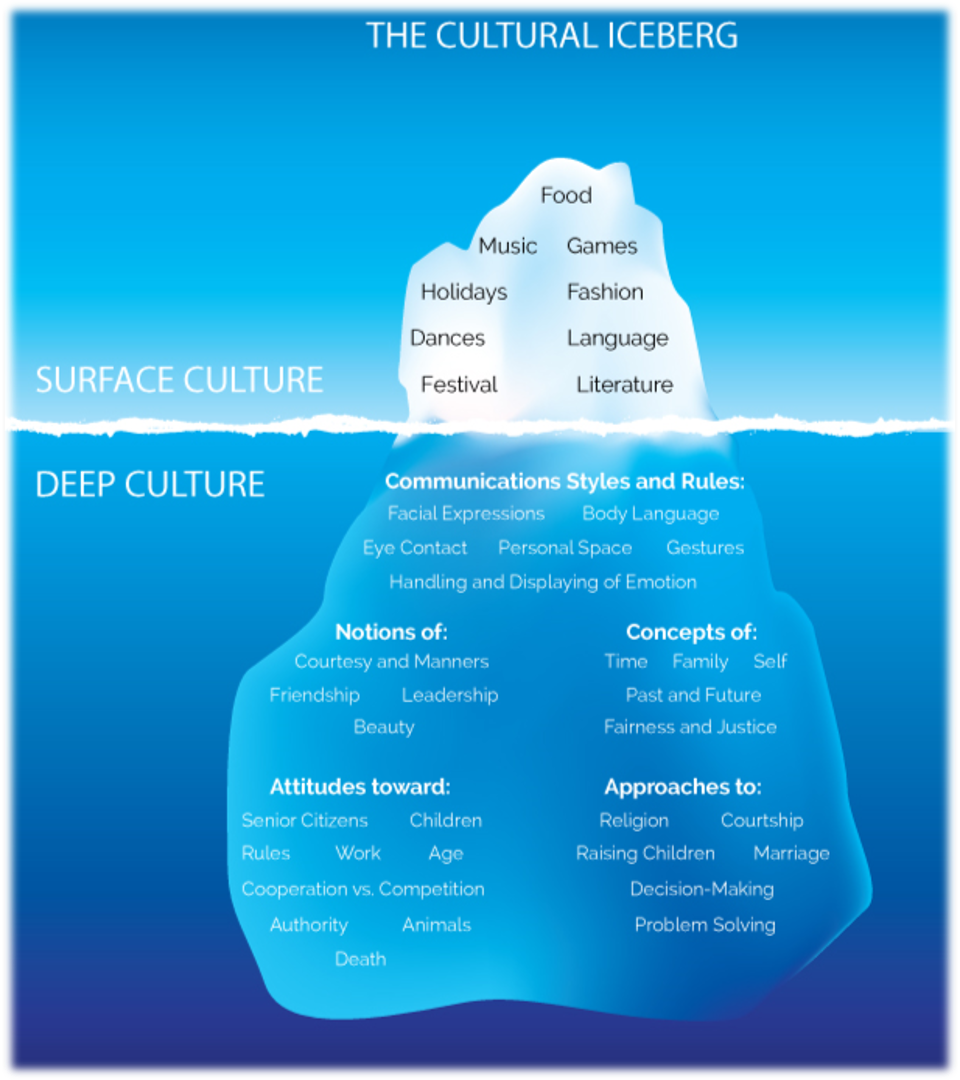
There are many different levels of culture, from family culture, to local culture, to national culture, organisational culture, and even to global regions such as “western culture”. What often comes to mind with regards to culture is that it is defined by what is obvious or seen. The Cultural Iceberg model below shows that this is only a fraction of what culture is. When thinking of another culture, we think of their festivals, traditional dress, languages, food, and games. However, under the surface there is a lot more detail to a culture that requires time, effort, and curiosity to explore.
Talking about culture can sometimes lead to unhelpful stereotypes. A framework that my colleagues and I find helpful, and has been received well in seminars, is to recognise the difference between cultural norms, and cultural stereotypes.
Cultural norms reflect how people in a group actually behave, and they help maintain social order within that group. These are the practices or behaviours that are regularly observed in a culture i.e. “in Japan, bowing is a common greeting”.
Cultural stereotypes reflect how people outside (or sometimes inside) a group perceive that group, often inaccurately. This tends to stem from bias or prejudice where behaviours are exaggerated or generalised i.e. “all people from x are y”.
What is Cultural Intelligence?
An official definition of Cultural Intelligence, or CQ is, “an individual’s capacity to function and manage effectively in culturally diverse settings”.2
I have found that skills in CQ are linked with Emotional Intelligence (EQ) in that it has aspects of self reflection and awareness, requires self management when engaging with different ideas and beliefs that may raise emotional responses, and utilises empathy and social awareness. CQ is a skill that goes beyond awareness of other cultures to being able to navigate relationships that cross cultural boundaries.

Recognising cultural difference can often raise a reaction in people who think their way of doing things is the “right” way or the “only” way of doing things or thinking about things. Different ways of thinking about God, time, death, marriage, or any number of things can lead to discomfort as long-held beliefs are often challenged in a multi-cultural environment. CQ helps us navigate this discomfort in a way that builds relationships.
There are multiple aspects of culture and CQ skills that I’ll cover over the next few blog posts but I believe the foundational skill for developing CQ is to practice curiosity. Part of curiosity is the ability to pause judgement, as modelled by the researcher and her landlady, even when offended by another person’s behaviour. I think curiosity is closely linked with humility as both help us recognise that how we do things and what we believe about reality is, for a significant part, a product of the environments we grew up in. Humility does not rush to make a moral judgement on whether the difference is right or wrong, good or bad. It helps us move towards building bridges rather than putting up barriers by seeing difference as something to learn from rather than a threat.
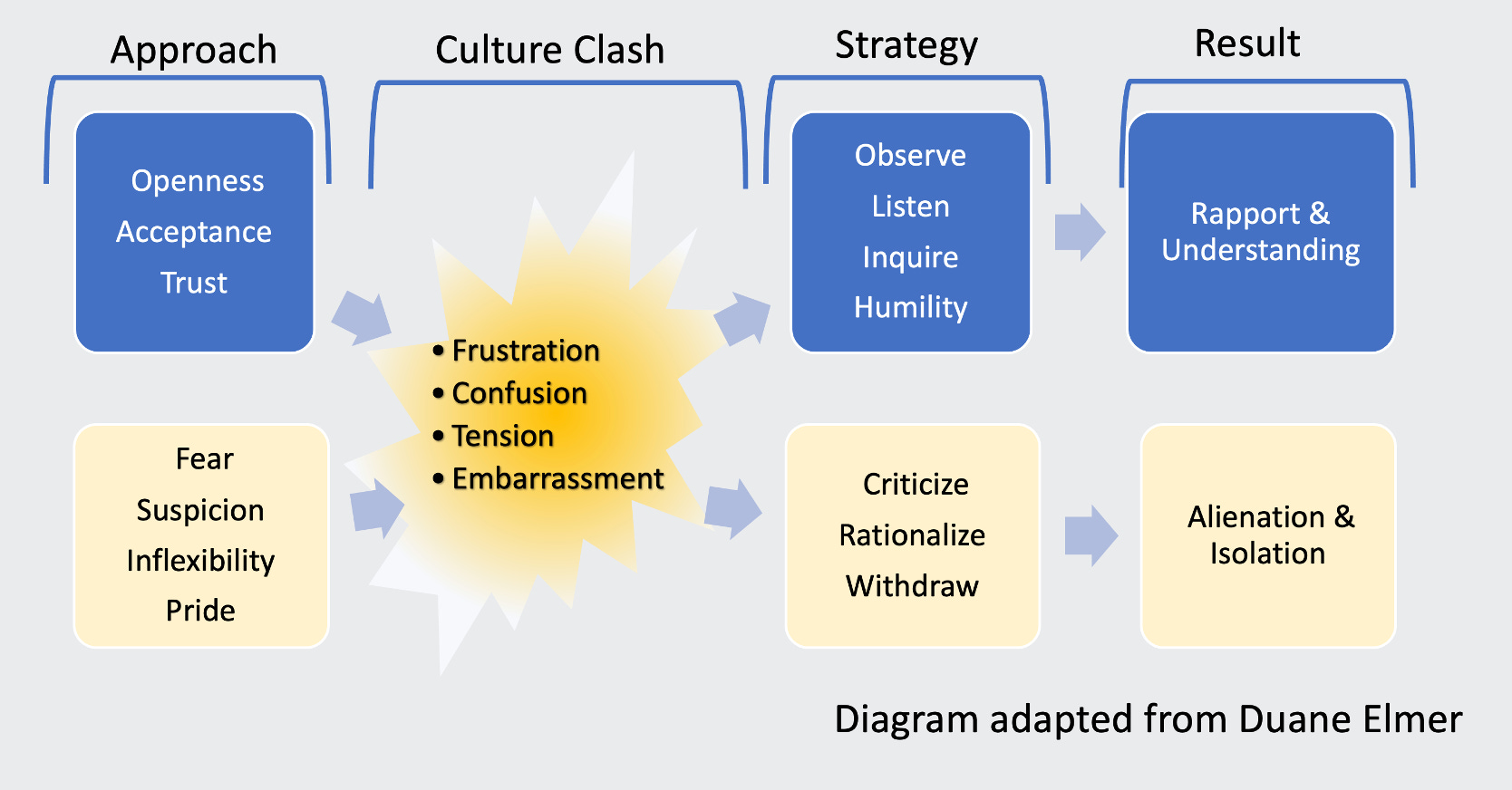
Duane Elmer3 offers the model above as a means of showing how a strategy of a humble attitude and an approach that seeks to learn from and accept difference, can lead to much healthier relational outcomes. Culture clash will happen, so reflecting on your response and approach to someone who has a different view of the world to you is a good starting point.
The following posts in this CQ series will cover the cultural impact on communication, relational dynamics, individual vs. group responsibility, handling cultural conflict, and more. If this is of interest to you, why not hit subscribe and follow along over the next few weeks.
If you currently work in a cross-cultural environment and would like to explore how coaching may be of benefit to you in improving cultural intelligence then please get in touch.
I’m a bit wary of talking about worldviews as many worldview models are overly simplistic. Even Lloyd Kwast who created a model of culture in the 1970s that suggests what is done and what is good comes out of a worldview, says of his model, it is “far too simple to explain the multitude of complex components and relationships that exist in every culture.”
Duane Elmer is a Christian author and teacher who has written a number of books on cross cultural engagement mostly in a context of Christian ministry. Unfortunately I can’t remember where I first encountered this diagram though I did reference him from the first time I used this diagram in a training session several years ago.