
What is Coaching?
"Most people think they know what coaching is, but most people are wrong." Sarah Short, The Coaching Revolution

I’ve heard many people use coaching in many different contexts but often the definitions are a bit blurred with those of mentoring, consulting, or counselling. I think the most helpful definition I’ve come across so far is, Timothy Gallwey’s:
“Coaching is unlocking a person’s potential to maximise their own performance, helping them to learn, rather than teaching them.”
Coaches do not lead or set the agenda, they simply ask questions the coachee can’t or are reluctant to ask themselves.
The following graphic highlights the differences between coaching, mentoring, counselling, and consulting and how it fits into providing support for people. Coaching provides a particular support that focuses on solving problems set by a client. This is done by drawing solutions from the client. This is contrasted with mentoring where the client needs to be given information from someone with more experience to help them find a solution.
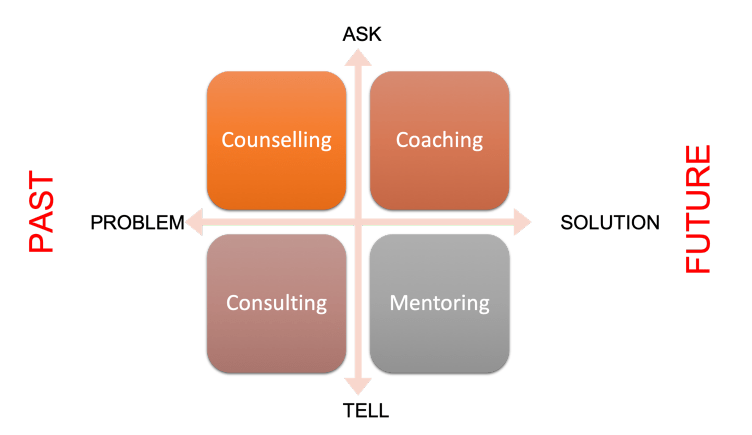
If you are seeking a mindset shift, a behavioural change, improvement in performance, or support in decision making, or just a place to think, then coaching could well be something that will help you.
If you are seeking advice from someone more experienced, then you need a mentor or supervisor. In some circumstances there may be some overlap, and it may be that in discussion this overlap can be part of the contract between coach and client.
If you are seeking to review the past and include some therapy, then coaching is not the right course of action and I’d recommend looking at counselling.
“I’d never considered getting coaching before working with Phil, but he was such a good listener and the questions he asked were so pertinent that he helped to think through issues that I’d been stuck for years.” - Trainee Chaplain
What is required of a coachee?
You will get the most out of a coaching session if you are open to change and engage with the content of the sessions.
You are willing to try new ways of learning, be truthful, keep to your commitments and inform your coach immediately when things are not working for you.
You are willing to explore, challenge and change thoughts, feelings and actions if you feel it will be beneficial for you.
I do my best to make the coaching space, be it online or in-person, a safe place to be vulnerable by holding everything confidentially in line with best safeguarding practice (I only share information externally if I’m concerned about yours or someone else’s wellbeing). All of this will be discussed in the first session, regularly referred to in the coaching space as the chemistry session.

How do I get started?
If you are interested in being coached or have more questions, please get in touch. Or, if you would like to just get started, book in a personal coaching session with me by using the link below.
Paid subscribers to this Substack get a 10% discount on coaching sessions with a code that is shared with you once subscription is confirmed.